Pump On, Pump Off: What the Pattern of Your Water Loss Is Telling You
How fast your pool drops with the pump running, with it off, and where the level stops are all clues to where the leak is.
October 19, 2026 · 4 min read
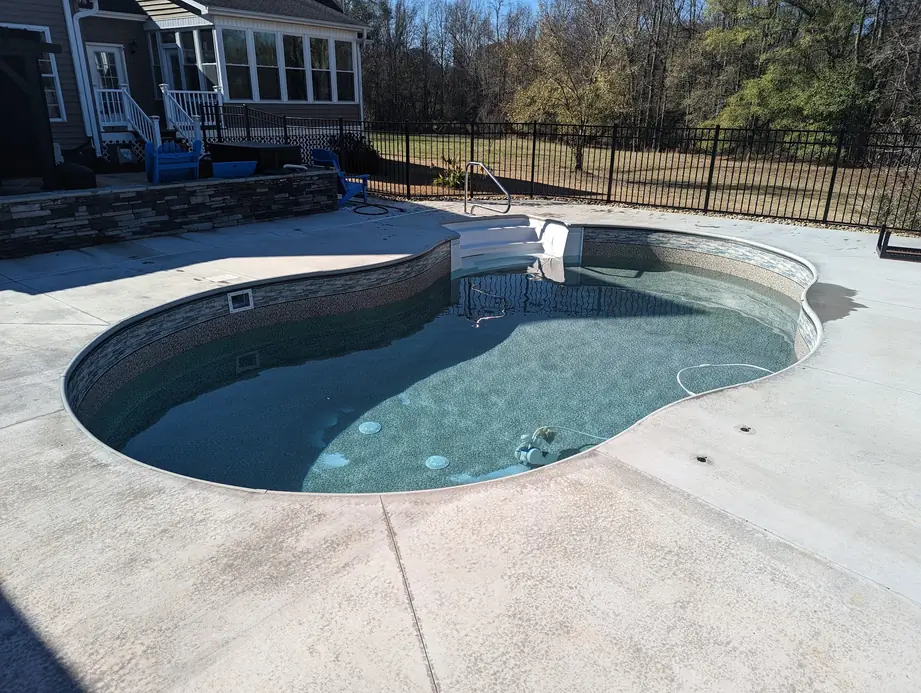
Once you know you are losing more water than evaporation explains, the next question is where it is going. You cannot see inside a pipe or behind a liner, but you can learn a lot from when the water leaves. How fast your pool drops with the pump running, how fast it drops with the pump off, and whether it stops at a certain height are all clues. None of them is proof, but together they shrink a big search into a small one.
Two sides of the plumbing
Your pool's plumbing has two sides. The suction side runs from the skimmers and main drain back to the pump, and while the pump is on it pulls on that water. The pressure side runs from the pump through the filter and heater and out to the return fittings, and while the pump is on it pushes. The shell, the skimmer bodies, the light niches and the fittings are a third category, because they hold water whether the pump is running or not.
What the pump-on pattern can tell you
A pressure-side leak is pushed on whenever the pump runs. The pipe or joint is under pressure, so water forces its way out of any weak spot. A pool with this kind of leak may lose noticeably more water on days the pump runs than on days it does not.
A suction-side leak often shows itself in a different way. Instead of water going out, air can be pulled in, and that shows up as bubbles in the pump basket, air in the pump, a pump that loses its prime, or weak suction at the skimmers. Air in the pump is on Aquatrace's list of common signs of a pool leak, and it is worth writing down when you see it.
What the pump-off pattern can tell you
With the pump off, the plumbing is no longer pushing or pulling, and water leaves only if it has somewhere to run. A pool that keeps losing water with the pump off is pointing at a leak that does not need pressure to work, such as a crack in the shell, a worn seal around a light niche or skimmer, or a line that sits below the water level. A pool that loses very little with the pump off, but drops faster once the pump starts, is pointing at the pressure-side plumbing.
Watch where the level stops
One of the best clues costs nothing. If the water falls and then stops at about the same height every time, the leak is probably at or near that height. Water only runs out through an opening while the water is above the opening. A level that settles just below the skimmer throat, partway down the wall, or at the bottom of a light niche is telling you which part of the pool to look at first. Put a strip of tape at the waterline and note where it settles each time.
How to try it yourself
- Pick a few days with similar weather, and mark the water level on the tile with tape.
- Run the pump normally for a day and record how far the level moved.
- Turn the pump off for a day and record the change again. Keep the auto-fill off for both days so it cannot hide anything.
- Compare the two numbers, and note the height where the level settles.
One safety note. If the level gets close to the bottom of the skimmer opening, shut the pump off. A pump that runs without water can be damaged quickly, and a low pool is no place to experiment. If you cannot keep the test going safely, stop and make the call.
Why a technician tests it both ways
A leak detection company is trying to answer the same question, only more completely. Aquatrace's process includes pressure testing of the filtration and the entire plumbing system, and a separate inspection of the pool and spa basin. Testing the plumbing under pressure and then looking at the shell on its own is how you tell a pipe problem from a structure problem. If the shell holds and the plumbing does not, the search moves to the pipes. If the plumbing holds and the level still falls, the search moves to the structure. Either result takes half of the pool off the list.
Finding a pipe leak under decking is a different job, and that is where listening comes in. Aquatrace uses water, air and specialized listening devices to hear underground plumbing under the deck, so the deck does not have to come up on a guess. One Google reviewer wrote that he had lost suction in both skimmer lines, and that after two or three hours Chris pinpointed the leak well enough that he could hear it himself. The next day he dug and found breaks in both lines exactly where Chris said they would be.
What to do with what you learn
Write down your numbers: loss per day with the pump on, loss per day with the pump off, and the height where the level settles. Add anything odd, such as air in the pump basket, weak suction, or a wet patch in the yard. Do not dig, cut or break anything on a hunch. A trench in the wrong place costs you more than the leak did.
When you have your notes, send a service request to Aquatrace or call (864) 710-8636. Your pump-on and pump-off numbers give Chris and Catherine Sears a solid place to start the conversation.
Aquatrace Swimming Pool Leak Detection, (864) 710-8636
Call (864) 710-8636More articles
Is Your Pool Leaking or Just Evaporating? How to Tell Before You Call
Every pool loses some water, so the real question is whether the sky can explain what you are losing.
Why a Pool Leak Detector Goes Underwater (and What Your Deck Can't Show)
Some of the most common leak spots in a pool can only be examined up close, from the inside.