Why a Pool Leak Detector Goes Underwater (and What Your Deck Can't Show)
Some of the most common leak spots in a pool can only be examined up close, from the inside.
October 19, 2026 · 4 min read
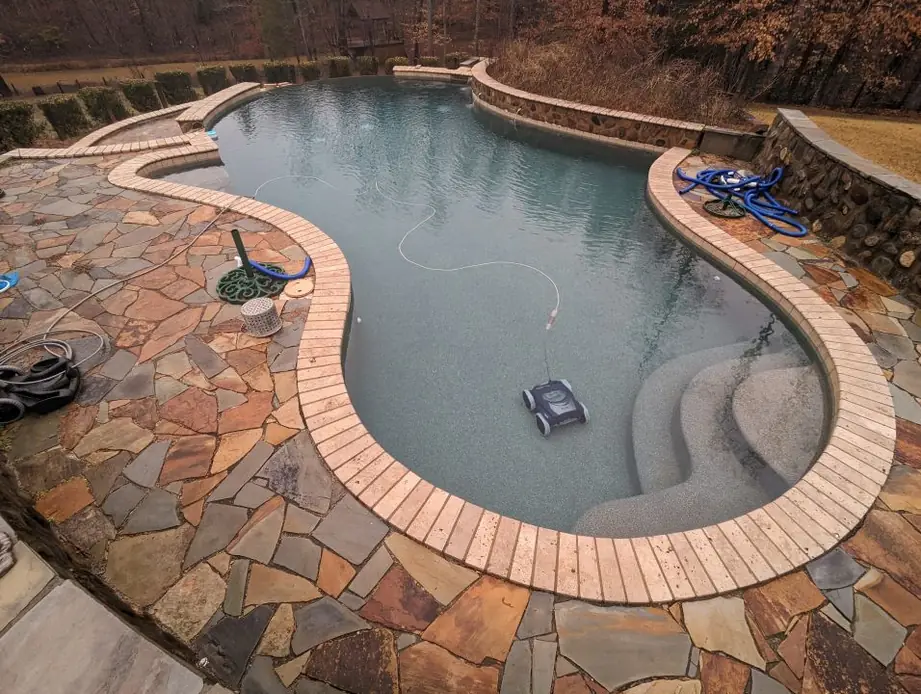
Most people picture a leak detective with headphones and a probe walking the pool deck. Aquatrace does plenty of that work. But the company also goes underwater. Chris Sears, Aquatrace's founder and lead inspector, is a NAUI dive professional and certified scuba instructor, and a SCUBA inspection of the pool shell is one of the methods the company lists. It can sound like a gimmick until you think about how much of a pool can only be seen from inside it.
What you can and cannot see from the deck
From the deck you see the surface of the water, the tile line, the coping and the equipment pad. Below the surface, everything is seen through moving water. Ripples bend the light, sun glare hides the floor, and the deep end is a long way down. A hairline crack, a loose fitting or a small tear in a liner can sit in plain view and still be invisible from standing height. You can look at a pool for an hour and see nothing, and the same pool can show you the answer in a few minutes up close.
Cracks in the shell
Concrete and gunite pools develop cracks as the ground shifts and the structure settles. Many cracks are only cosmetic. Some leak. The trouble is that a crack that leaks does not look different from one that does not, until someone examines it closely. A diver can put a face and a hand right at a suspect crack, look at its edges, and use dye to watch whether the water around it is being drawn into the shell. Dye testing is one of the methods Aquatrace uses, and underwater it shows you movement that the eye cannot otherwise see.
Fittings, skimmers and the main drain
Where plumbing meets the shell is where many leaks live. Return fittings, the skimmer throat, the main drain and any spot where a pipe passes through the wall all rely on seals, gaskets and sealant that are asked to hold for years while different materials move at different rates. A fitting can look perfectly fine from above while the seal around it has pulled back from the wall. Underwater, the inspector can check each one at eye level instead of guessing at it.
Light niches
A light niche is a hole through the pool wall that holds a light fixture, with conduit running to it from the equipment side. That makes it a place where water can find a path out, around the fixture, through the gasket, or along the conduit. It is also a spot that is easy to overlook, because a pool light that works does not look like a leak. A close look at the niche and its surroundings is part of a thorough shell inspection.
Liners, tears and wrinkles
In a vinyl liner pool, the liner is the waterproofing. A small puncture, a tear along a seam, or a spot where the liner has pulled loose from a fitting can all let water out. These are far easier to spot at close range, where you can see the edge of a tear and see whether it has moved. If a leak turns out to be a simple vinyl repair, Aquatrace includes simple epoxy and vinyl repairs at no additional charge with the service fee.
The pictures that come back with the report
The underwater work does not only help the technician. Aquatrace takes underwater photographs during the inspection, and a digital copy of the findings report is emailed to you afterward. That matters more than it might seem. When a crack, a fitting or a tear has a photograph attached, you are not taking anyone's word for what is down there. You can look at it yourself. If the repair is bigger than a simple one, you also have something concrete to hand to the original builder or whoever does the work, which makes for a much better conversation than a description over the phone. Aquatrace consults on major repairs and recommends the most cost effective solution, and its pictures back up that advice.
How to get your pool ready
A diver needs water, so please do not drain the pool before the visit. Aquatrace asks that covers be removed, that the pool and spa be clean and balanced, that the water be at its normal operating level, and that the inspection areas be free of obstructions. Clean, balanced water also helps everyone see what is down there. If you have a spa, it gets the same treatment, since the pool and spa basin are both part of the reservoir inspection.
Not every company can do this
Aquatrace's own profile of Chris notes that many leak detection companies in its markets are not equipped to handle underwater shell inspection. Catherine Sears is scuba certified as well. If a leak turns out to be in the shell or its fittings, that capability is the difference between pointing at a spot and wondering about one. It is worth asking any company you call whether they can inspect the shell itself or only listen from the deck.
If you suspect a crack, a fitting or a liner problem, send a service request to Aquatrace or call (864) 710-8636 to talk about your pool.
Aquatrace Swimming Pool Leak Detection, (864) 710-8636
Call (864) 710-8636More articles
Is Your Pool Leaking or Just Evaporating? How to Tell Before You Call
Every pool loses some water, so the real question is whether the sky can explain what you are losing.
Pump On, Pump Off: What the Pattern of Your Water Loss Is Telling You
How fast your pool drops with the pump running, with it off, and where the level stops are all clues to where the leak is.